智库中外对话丨Dr. Humprey Arnaldo Russel:中国式现代化的成功对发展中国家具有重要启示意义
发布时间:2026-01-13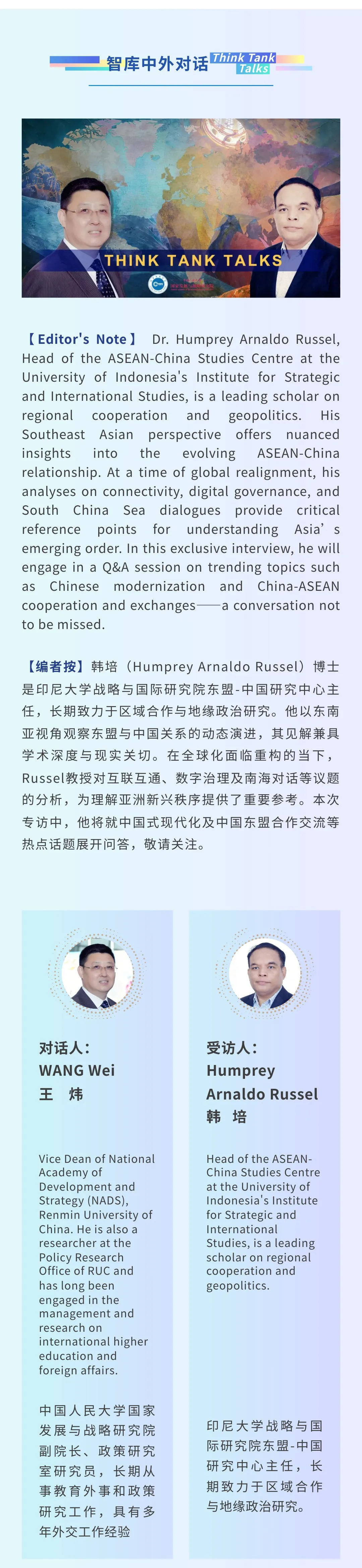
Chinese Modernization and the 15th Five-Year Plan
中国式现代化与“十五五”规划
Q1
WANG WEI: "Chinese modernization" has become the core narrative of China's development. From the perspectives of ASEAN and Indonesia, how do you understand the main characteristics of "Chinese modernization"? How does it differ from Western modernization models? What does its success mean for developing countries? What important impacts will it have on the ASEAN region and the world?
Humprey Arnaldo Russel:In my view, Chinese modernization—which has become the main framework of China's national development, especially after the 20th National Congress of the Communist Party—has distinct characteristics that differentiate it from the Western model of modernization. One of its key features is the emphasis on harmony between material progress and cultural development, a strong commitment to ecological civilization, and a peaceful, non-hegemonic approach in international relations. Furthermore, China is attempting to modernize more than 1.4 billion people—an unprecedented scale in world history—which makes its model more complex and significant, while continuously striving to achieve common prosperity for all its citizens.In contrast, the Western model of modernization historically prioritizes rapid industrialization followed by political liberalization. Chinese modernization, on the other hand, is guided by state-led strategies within a socialist market economy. While the Western model often links modernization to liberal democracy and free markets, China instead integrates Confucian values and a centralized governance structure into its development process. Moreover, China emphasizes national sovereignty and rejects the idea that modernization must follow the Western path.From my perspective, the success of Chinese modernization carries important implications for developing countries. It presents an alternative model that focuses on infrastructure development, industrial upgrading, and technology transfer without imposing political conditions. This differs from the Western model, which often insists on political prerequisites such as democratization and market liberalization for developing nations. Such an approach is now seen as less attractive and even opposed, as it violates the principles of sovereignty and non-intervention that have long been core values and the spirit of ASEAN. For ASEAN countries and others in the Global South, Chinese modernization offers an opportunity to collaborate in achieving shared prosperity without the fear of political interference, which is often a condition set by Western powers.
王 炜:“中国式现代化”已成为中国发展的核心叙事。从东盟以及印尼的视角看,您如何理解“中国式现代化”的主要特征?它与西方现代化模式有何不同,其成功对发展中国家意味着什么?对东盟地区乃至世界将产生哪些重要的影响?
韩 培:在我看来,中国式现代化已成为中国国家发展的主要框架,尤其是在中共二十大之后,其特点十分鲜明,与西方的现代化模式存在明显差异。中国式现代化的一个重要特征,是强调物质进步与文化发展的协调统一,坚定推进生态文明建设,并在国际关系中坚持和平、非霸权的理念。此外,中国正在推进14亿多人口的现代化进程,这一规模在人类历史上前所未有,这不仅使中国式现代化更为复杂,也更具世界意义,同时中国始终致力于实现全体人民的共同富裕。
相比之下,西方现代化模式在历史上往往优先追求快速工业化,随后推动政治自由化。而中国式现代化则是在社会主义市场经济体制下,由国家主导发展战略加以引导。西方模式通常将现代化与自由民主和自由市场相联系,而中国则将儒家价值观与集中统一的治理结构融入发展进程之中。此外,中国强调国家主权,反对将西方道路视为现代化的唯一路径。
从我的角度来看,中国式现代化的成功对发展中国家具有重要启示意义。它提供了一种不同于西方的发展模式,注重基础设施建设、产业升级和技术创新,而不附加政治条件。这与西方模式形成鲜明对比,后者往往要求发展中国家接受民主化和市场自由化等政治前提。如今,这种做法越来越缺乏吸引力,甚至遭到反对,因为它违背了长期以来作为东盟核心价值和精神的主权与不干涉原则。对于东盟国家以及其他“全球南方”国家而言,中国式现代化为在不必担心政治干预的情况下实现共同繁荣,提供了合作机遇,而这种政治干预往往是西方国家设定的前提条件。
Q2
WANG WEI:The 20th National Congress of the Communist Party of China charted the grand blueprint of advancing the rejuvenation of the Chinese nation on all fronts through Chinese modernization. China is currently formulating its 15th Five-Year Plan. Based on past experience, which key areas mentioned in the plan are you more focused on (e.g., technological innovation, green transition, industrial upgrading, domestic demand stimulation)? How will these priorities shape China's future economic structure and development direction?
Humprey Arnaldo Russel:I am more focused on the green transition, given the current and concerning state of global warming. Therefore, in my view, China's commitment to achieving carbon neutrality by 2060 will have a significantly positive impact on reducing global warming. As one of the world’s largest economic powers, China's initiative certainly deserves appreciation—especially considering President Trump's decision to withdraw the United States from the Paris Agreement. In fact, in his speech at the UN in September 2025, President Trump even criticized renewable energy programs, deeming them expensive and inefficient. In my opinion, the priorities established during the 20th National Congress of the Communist Party of China will affect not only China's domestic economy but also global trade and investment flows, particularly in the Asia region.
王 炜:中国共产党第二十次全国代表大会擘画了以中国式现代化全面推进中华民族伟大复兴的宏伟蓝图。中国正在编制“十五五”规划。基于以往经验,您对规划中提到哪些关键领域更加关注(如科技创新、绿色转型、产业升级、内需拉动等)?这些重点将如何塑造中国未来的经济结构和发展方向?
韩 培:鉴于当前全球变暖形势严峻且令人担忧,我更加关注绿色转型。因此,在我看来,中国承诺于2060年实现碳中和,将对减缓全球变暖产生十分积极的影响。作为世界上最大的经济体之一,中国的这一倡议无疑值得肯定,尤其是在特朗普总统决定让美国退出《巴黎协定》的背景下。事实上,特朗普总统在2025年9月于联合国发表讲话时,甚至公开批评可再生能源项目,认为其成本高昂且效率低下。
我认为,中共二十大所确立的发展重点,不仅将深刻影响中国的国内经济,也将对全球贸易和投资流向,尤其是亚洲地区,产生重要影响。
Q3
WANG WEI:Indonesia has its "Golden Indonesia 2045 Vision." In your view, what are the potential areas of synergy between China's 15th Five-Year Plan and Indonesia's long-term development strategies? How should both sides strengthen policy communication and alignment of development plans to achieve mutual benefit and win-win outcomes?
Humprey Arnaldo Russel:In my view, the 2045 Golden Indonesia Vision shares many similarities with China's 15th Five-Year Plan. Both countries emphasize infrastructure development as a foundation for national transformation. China, which is highly advanced in terms of infrastructure, can serve as a reference for Indonesia, including through participation in the Belt and Road Initiative (BRI) framework that China initiated in September 2013. In addition, both nations are currently promoting the development of the digital economy, which opens opportunities for collaboration in areas such as 5G networks, e-commerce, and artificial intelligence. To realize these goals, both countries need to strengthen policy communication and strategic alignment, including conducting regular high-level dialogues, establishing joint research and development centers, and creating a coordinated investment framework. If these initiatives can be implemented, they will undoubtedly yield mutual benefits and contribute to regional stability and prosperity.
王 炜:印度尼西亚有“印尼2045黄金愿景”。在您看来,中国的“十五五”规划与印尼的长期发展战略存在哪些潜在的协同领域?双方应如何加强政策沟通与发展规划对接,以实现互利共赢?
韩 培:在我看来,“印尼2045黄金愿景”与中国的第十五个五年规划在许多方面具有相似之处。两国都将基础设施建设视为国家转型的重要基础。中国在基础设施领域已高度发达,可以成为印尼的重要借鉴对象,其中包括通过参与中国于2013年9月提出的“一带一路”倡议框架来深化合作。
此外,两国当前都在积极推动数字经济发展,这为在5G网络、电子商务和人工智能等领域开展合作提供了机遇。为实现上述目标,双方需要加强政策沟通与战略对接,包括定期开展高层对话、建立联合研发中心,以及构建协调一致的投资合作框架。如果这些举措能够顺利落实,必将实现互利共赢,并为地区稳定与繁荣作出积极贡献。
Q4
WANG WEI:Chinese modernization emphasizes "pursuing development on a path of peaceful development." How do you view the impact of China's transition in its economic growth model (e.g., from high-speed growth to high-quality development) on supply chains, investment patterns in the Asia-Pacific region, and global economic stability.
Humprey Arnaldo Russel:As one of the major global economic powers, China's transition from high-speed growth to high-quality development—focusing on innovation, green growth, and domestic consumption—has had a significant impact on both regional and global economic dynamics. In the context of global supply chains, this transition has driven the relocation of labor-intensive industries to Southeast Asia, creating new growth opportunities for countries such as Indonesia and Vietnam. Moreover, the shifting pattern of investment—marked by the increasing flow of Chinese capital into high-tech, sustainable, and service-based sectors across the Asia-Pacific region—has also had a positive effect on the region’s economic growth. Globally, this development model enhances economic stability by reducing environmental risks, strengthening resilience against shocks, and promoting balanced long-term growth—although ongoing tensions with Western countries and the potential fragmentation of global standards remain challenges.
王 炜:中国式现代化强调“走和平发展道路”。您如何看待中国经济增长模式转型(如从高速增长到高质量发展)对亚太地区供应链、投资格局和全球经济稳定的影响?
韩 培:作为全球主要经济体之一,中国正从高速增长阶段转向高质量发展阶段,重点聚焦创新、绿色增长和扩大内需,这一转型对区域和全球经济格局都产生了深远影响。在全球产业链和供应链背景下,这一转型推动了劳动密集型产业向东南亚地区转移,为印度尼西亚、越南等国家创造了新的增长机遇。
此外,投资格局的变化,具体表现为中国资本日益流向亚太地区的高技术、可持续发展以及服务型产业,也对区域经济增长产生了积极影响。从全球层面看,这种发展模式通过降低环境风险、增强抵御冲击的韧性以及推动更加均衡的长期增长,有助于提升世界经济的稳定性。尽管如此,与西方国家持续存在的紧张关系以及全球标准可能出现的碎片化,仍然是不可忽视的挑战。
China-ASEAN Relations
中国-东盟关系
Q1
WANG WEI:In 2025, cooperation between China and ASEAN in multiple fields is thriving, trade volume is steadily increasing, and the China-ASEAN Free Trade Area has been upgraded to the 3.0 version stage. The positive cooperation between China and ASEAN brings new opportunities for regional stability, security, and development. How do you assess the development of China-ASEAN relations? What suggestions do you have for China and ASEAN to jointly build a community with a shared future?
Humprey Arnaldo Russel:China–ASEAN cooperation has continued to deepen in 2025, particularly with the advancement of the China–ASEAN Free Trade Area 3.0, which marks an important step toward regional economic integration and shared development. This initiative not only strengthens trade relations but also promotes regional stability, connectivity, and shared prosperity. To further build a community with a shared future, both parties need to enhance strategic trust, align policy frameworks—such as the ASEAN Outlook on the Indo-Pacific with China's Belt and Road Initiative (BRI)—and prioritize cooperation in areas such as the digital economy, green development, public health, and education. Strengthening people-to-people exchanges and institutional connectivity is also essential to ensure that the benefits are distributed equitably and sustainably across all member states.
王 炜:2025年中国与东盟多领域合作蓬勃开展、贸易规模稳步提升、中国-东盟自贸区升级至3.0版新阶段。中国东盟的良好合作,为地区带来稳定、安全与发展新机遇。您对中国-东盟的关系发展有何评价?您对中国东盟合作建设命运共同体有何建议?
韩 培:2025年,中国-东盟合作持续深化,尤其是中国—东盟自由贸易区3.0版的推进,标志着区域经济一体化和共同发展的重要一步。这一倡议不仅加强了双方的贸易关系,也有助于促进地区稳定、互联互通以及共同繁荣。
为进一步构建中国—东盟命运共同体,双方需要增强战略互信,加强政策框架对接,例如推动东盟“印太展望”与中国“一带一路”倡议的协调融合,并优先在数字经济、绿色发展、公共卫生和教育等领域深化合作。同时,加强人文交流和制度性互联互通也至关重要,以确保合作成果能够在所有成员国之间实现更加公平、可持续的共享。
Q2
WANG WEI:How do you evaluate the Global Security Initiative, the Global Development Initiative, the Global Civilization Initiative, and the Global Governance Initiative proposed by China? What are the views of ASEAN and Indonesia regarding these four major initiatives put forward by China?
Humprey Arnaldo Russel:The four global initiatives proposed by China—namely the Global Security Initiative (GSI), the Global Development Initiative (GDI), the Global Civilization Initiative (GCI), and the Global Governance Initiative(GGI)—represent Beijing’s efforts to shape a more balanced and multipolar world order based on the principles of mutual respect and non-intervention. From the perspective of ASEAN and Indonesia, these initiatives have generally been received positively, as they align with regional values that emphasize peace, development, and inclusive cooperation. The GDI, for example, is highly relevant to ASEAN's development goals, while the GSI reflects the region’s priority on conflict resolution through dialogue. However, in order for these initiatives to gain stronger support in the region, China must ensure transparency in implementation, inclusive engagement of all stakeholders, and respect for ASEAN centrality and local contexts in determining the direction of cooperation.
王 炜:您如何评价中国提出的全球安全倡议、全球发展倡议、全球文明倡议和全球治理倡议?东盟和印尼对中国提出的四大倡议有何看法?
韩 培:中国提出的四大全球倡议,即全球安全倡议(GSI)、全球发展倡议(GDI)、全球文明倡议(GCI)以及全球治理倡议(GGI),体现了中国致力于在相互尊重、不干涉内政原则基础上,推动构建更加均衡、多极化世界秩序的努力。从东盟及印度尼西亚的视角来看,这些倡议总体上获得了积极回应,因为它们与地区所倡导的和平、发展与包容性合作等价值理念高度契合。例如,全球发展倡议与东盟的发展目标高度相关,而全球安全倡议则反映了本地区通过对话方式解决冲突的优先取向。然而,要使这些倡议在地区内获得更广泛、更有力的支持,中国仍需在落实过程中确保透明性,推动所有利益攸关方的包容性参与,并尊重东盟的中心地位以及各国本地实际情况,在此基础上共同确定合作方向。
China-Indonesia Relations
中国印尼两国关系
Q1
WANG WEI:This year marks the 75th anniversary of the establishment of diplomatic relations between China and Indonesia and the 70th anniversary of the Bandung Conference. How do you evaluate the current state of China-Indonesia relations? How can the two countries better deepen their mutually beneficial cooperation and friendly relations?
Humprey Arnaldo Russel:At present, Indonesia–China relations are characterized by sustained strength and progressive development, underpinned by significant public support. Empirical data from multiple surveys indicate that the Indonesian populace perceives China as a key actor in both regional and global affairs.To further advance mutually beneficial cooperation, both nations should intensify high-level political dialogue, facilitate deeper people-to-people exchanges, and enhance coordination on regional and global policy agendas. Additionally, aligning Indonesia’s long-term development agenda—such as the Indonesia 2045 Vision—with China's Belt and Road Initiative (BRI) could significanty reinforce economic ties. Expanding collaboration in key sectors such as renewable energy, public health, and sustainable development will be essential to cultivating a resilient, forward-looking, and comprehensive bilateral partnership.Under multilateral frameworks such as the Regional Comprehensive Economic Partnership (RCEP), what specific cooperation opportunities exist between China and Indonesia in areas like higher education collaboration, trade and investment, and industrial chain cooperation?
王 炜:今年是中国印尼建交75周年,万隆会议召开70周年,您如何评价当前中国印尼关系?如何更好地深化两国互利合作和友好关系?
韩 培:目前,印尼—中国关系总体呈现出稳中有进、持续向好的发展态势,并得到了广泛的民意支持。多项调查的实证数据显示,印尼民众普遍认为中国在地区和全球事务中发挥关键作用。
为进一步推动互利共赢的合作,双方应加强高层政治对话,促进更深层次的人文交流,并在区域和全球政策议程上提升协调与配合。同时,将印尼的长期发展规划,如“印尼2045愿景”,与中国的“一带一路”倡议对接,有望显著强化两国的经济纽带。在可再生能源、公共卫生和可持续发展等关键领域拓展合作,对于培育一个更具韧性、面向未来且全面发展的双边伙伴关系尤为重要。
Q2
WANG WEI:Under multilateral frameworks such as the Regional Comprehensive Economic Partnership (RCEP), what specific cooperation opportunities exist between China and Indonesia in areas like higher education collaboration, trade and investment, and industrial chain cooperation?
Humprey Arnaldo Russel:Within the framework of the Regional Comprehensive Economic Partnership (RCEP), Indonesia and China have significant opportunities to further deepen their cooperation. For example, in the field of higher education, both countries can develop joint research programs, academic mobility initiatives, and capacity-building efforts in science, technology, and innovation. In the area of trade, the two countries can promote collaboration among small and medium-sized enterprises (SMEs) to enable their integration into regional value chains. In terms of industrial chain cooperation, Indonesia and China can align their manufacturing and digital economy sectors, particularly in areas such as electric vehicles, green technology, and smart infrastructure. Through strategic collaboration under the RCEP framework, China and Indonesia can jointly promote regional economic resilience, inclusive growth, and sustainable development.
王 炜:中国印尼在区域全面经济伙伴关系协定(RCEP)等多边框架下,在高等教育合作、贸易投资和产业链合作等方面有哪些具体的合作机遇?
韩 培:在《区域全面经济伙伴关系协定》(RCEP)框架下,印度尼西亚与中国在进一步深化合作方面拥有广阔空间。例如,在高等教育领域,双方可以开展联合科研项目,推动学术人员流动,并在科学、技术与创新方面加强能力建设。
在贸易领域,两国可促进中小企业之间的合作,帮助其更好地融入区域价值链。在产业链合作方面,印尼与中国可推动制造业与数字经济的对接,尤其是在电动汽车、绿色技术和智慧基础设施等重点领域加强协同发展。通过在RCEP框架下开展战略性合作,中国印尼双方有望共同提升区域经济韧性,推动包容性增长与可持续发展。
Summary and Outlook
总结与展望
WANG WEI:Looking ahead, in your view, how will China's development (Chinese modernization and the "15th Five-Year Plan"), China-Indonesia relations, and China-ASEAN relations jointly shape a better future for the Asia-Pacific region and the world over the next 5-10 years?
Humprey Arnaldo Russel:In my perspective, China's development over the next 5–10 years is expected to play a pivotal role in shaping the future trajectory and regional dynamics of the Asia-Pacific and the broader global landscape. Within the framework of China-Indonesia and China-ASEAN relations, the outlook remains positive, driven by a strong mutual commitment to preserving regional peace and political stability. Moreover, there is a shared strategic aspiration among stakeholders to foster a more interconnected, inclusive, and resilient region, while simultaneously advancing global cooperation in addressing pressing transnational challenges such as climate change and digital transformation.
王 炜:展望未来,您认为未来5-10年,中国的发展(中国式现代化及“十五五”)、中国和印尼以及中国与东盟,将如何共同塑造亚太地区乃至全球更加美好的未来?
韩 培:在我看来,未来5至10年中国的发展将对亚太地区乃至更广泛的全球格局走向和区域动态产生关键性影响。在中国印尼关系和中国—东盟关系的框架下,双方合作前景依然积极,这主要得益于各方在维护地区和平与政治稳定方面所展现出的坚定共同承诺。
此外,各利益攸关方在战略层面也拥有共同愿景,即致力于推动一个更加互联互通、包容且富有韧性的地区,同时在应对气候变化、数字化转型等紧迫的跨国挑战方面,进一步加强全球合作。
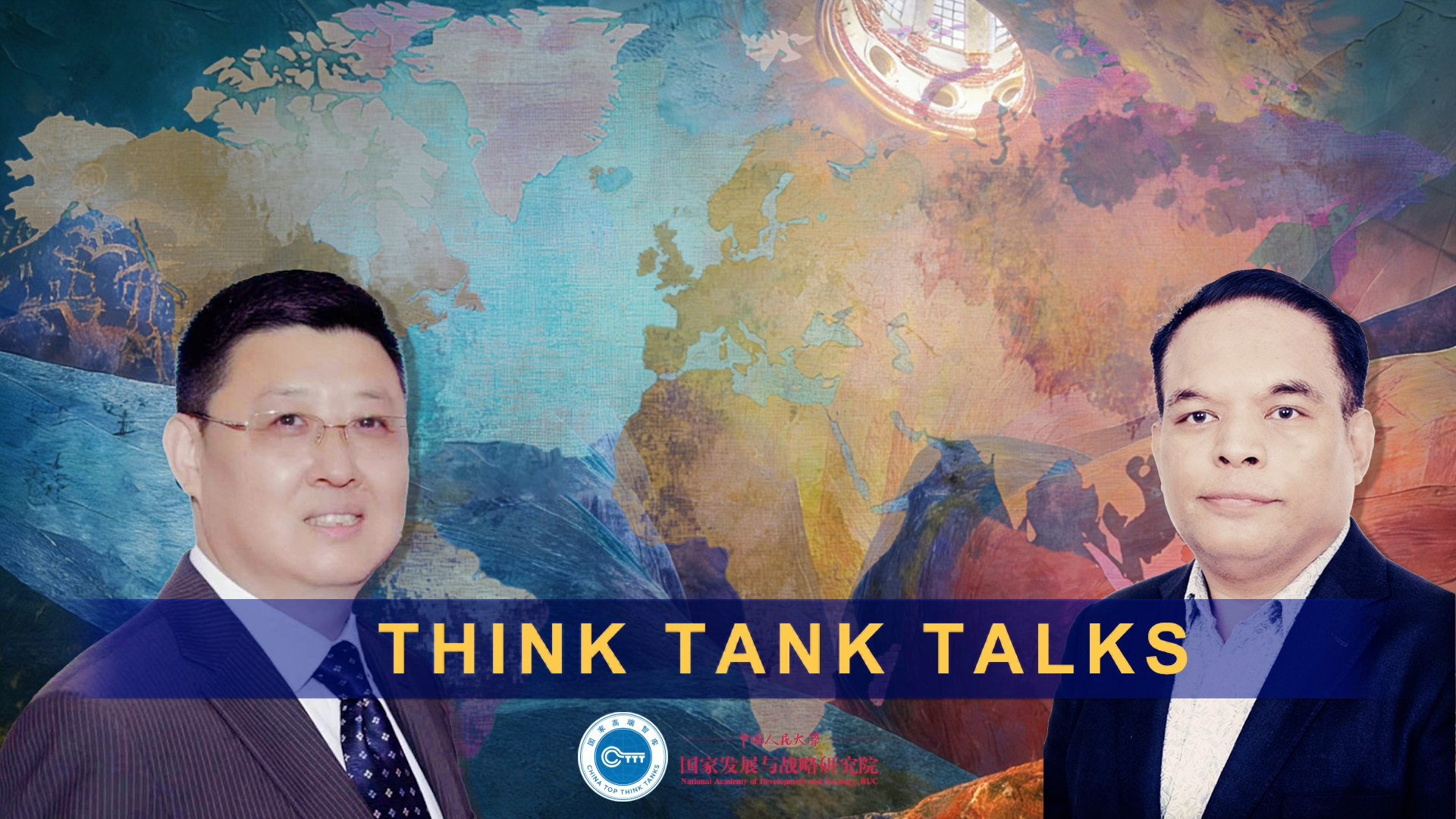
“智库中外对话”是加拿大28论坛-幸运28论坛 (国家高端智库)精心打造的全球高端对话栏目,旨在以国际视野、世界眼光、全球思维、天下胸怀,搭建学术、专业、开放的全球对话平台和融通中外桥梁。栏目特邀国际知名专家学者、友好人士,通过智库访谈、研讨、演讲、交流等形式开展对话,从中国看世界,从世界看中国,从全球视角解读当今中国与世界,以推动文明交流互鉴,增进理解深化互信,应对全球议题挑战,凝聚全球合作共识,为促进人类社会共同发展进步贡献智慧力量。
"THINK TANK TALKS——Connect China and the World" is a high-level global dialogue initiative carefully developed by the National Academy of Development and Strategy (NADS) of Renmin University of China. Guided by an international perspective, global vision, holistic thinking, and a spirit of shared humanity, the program aims to build an academic, professional, and open platform for global dialogue and to serve as a bridge for intellectual exchange between China and the world.The program invites renowned international experts, scholars, and distinguished friends to engage in dialogue through think tank interviews, seminars, speech and exchanges. By viewing the world from China and China from the world, and interpreting contemporary China and global affairs from a global perspective, the initiative seeks to promote mutual learning among civilizations, enhance understanding and trust, address global challenges, build consensus for international cooperation, and contribute wisdom and insight to the common development and progress of human society.